

An Engineers Australia assessor reaches a first judgement on your structure before reading a line of your technical analysis. Get the career episode format wrong, and a missing date or a blurred section boundary raises doubt on that first pass, however strong the engineering underneath happens to be. This guide takes each of the four mandatory sections and gives you its structural job, a recommended word allocation, and the exact condition that gets it flagged. Every figure below reflects the current Engineers Australia Migration Skills Assessment (MSA) Booklet and its companion guidance on writing career episodes.
What Engineers Australia assessors look for in a career episode
A career episode is a first-person narrative of one engineering project or role, written to prove you personally performed engineering work at the level Engineers Australia expects. Your Competency Demonstration Report (CDR) needs three of them. Assessors do not read them as stories. They scan for the structural markers the career episode format is built around so they can locate your individual competence fast.
The three-episode requirement and the 1000-2500 word range
Engineers Australia requires three career episodes, each running 1000 to 2500 words. Three is not padding. Each episode is a separate sample of your career, and three distinct samples let an assessor see competence across different problems, technologies, and responsibilities rather than one lucky project. Reuse the same activity three times and you hand the assessor one data point dressed as three.
Pick three genuinely different pieces of work: different projects where you can, or at minimum different engineering activities within a long role. Number every paragraph inside each episode (1.1, 1.2, 1.3, and so on) so your later Summary Statement can point back to a precise claim.
How the four sections map to EA competency criteria
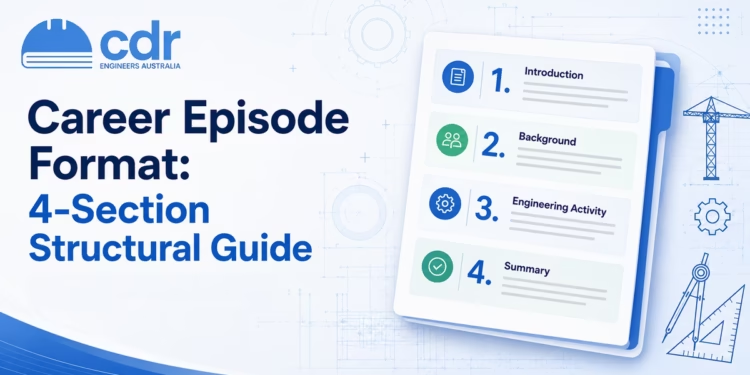
Every episode uses the same four sections: Introduction, Background, Personal Engineering Activity, and Summary. Each section does a different job. The opening two establish who, where, and what, and carry no competency claims at all. The Personal Engineering Activity (PEA) is where you evidence the Stage 1 competency elements, grouped by Engineers Australia into three clusters: Knowledge and Skill Base, Engineering Application Ability, and Professional and Personal Attributes. The Summary then recaps which of those you demonstrated. Load competency evidence into the wrong section and the assessor has to hunt for it, which is exactly the friction the format exists to remove.
Introduction: establish the project in under 200 words
Keep the Introduction short. In a 2000-word episode, it runs about 150 words, and its only task is to orient the assessor before the real evidence starts.
The four facts every Introduction must state
State four things, plainly: the chronology (start and end dates as month and year), the geographical location and the organisation you worked for, the project’s actual name, and your own designation on it. Miss any one and the section has failed its single job.
Failure trigger, Introduction: the section fails when project name, start and end dates, employing organisation, or your designation is absent.
Why vague titles and missing dates raise early doubt
Vagueness at the top primes an assessor to distrust everything below it. Compare the two openers.
Weak: “I worked on a water treatment plant project for about two years at a civil engineering firm.”
Strong: “From March 2016 to May 2018, I worked as Project Design Engineer on the Al Karama Water Treatment Plant Upgrade at Delta Civil Consultants in Amman, Jordan.”
The strong version fixes the project in time, place, and responsibility in one sentence. The weak version leaves the assessor guessing at all four facts, and an assessor who has to guess starts looking for reasons to doubt.
Background: place yourself inside the project environment
The Background sets the stage so the assessor can size your contribution. Give it roughly 350 words in a 2000-word episode, enough to frame the project without drifting into engineering work that belongs in the PEA.
What to include about your organisation, team, and scope
Describe the organisation and its business, the project’s objective and scale, the size and shape of the team, and where you sat in the reporting line. A one-line duty statement helps the assessor place you. Say what the project had to achieve and the constraints it faced: budget, schedule, a design standard, a site limitation.
Failure trigger, Background: the section fails when your position within the project hierarchy is not stated. Without that anchor, the individual work in the PEA has no context from which to read your authority.
Describing a team role without erasing your contribution
Most real engineering happens in teams, and Engineers Australia knows this. The risk is letting the team swallow you. Set the collective scope in a sentence, then carve out your slice. Instead of “the team delivered the detailed design of the pump station,” write “the team delivered the detailed design of the pump station, and I owned the hydraulic sizing and the surge analysis for it.” The team context stays, and your boundary is now visible.
Personal Engineering Activity: your core evidence section
The PEA is the episode. Carrying roughly 70% of the word count, about 1400 words in a 2000-word episode, this is the only section that proves competence. Everything before it was scene-setting.
Structuring your technical work in chronological order
Walk your work in the order it happened: the problem you faced, the options you weighed, the analysis you ran, the decision you made, and the outcome you verified. A strong technical passage names the exact problem, the diagnostic method applied step by step, the root cause found, and the specific fix. When a commissioning fault shows up as excess vibration at a sensor, you show the parameter tests that isolated it, the tolerance issue behind it, and the component change that resolved it, in that sequence. Chronology gives the assessor a thread to follow and makes your reasoning auditable.
Linking each engineering action to a competency element
Competitor pages tell you to “map your paragraphs to competency elements” and then never show what that looks like. Here it is inside a single sentence, with the element flagged:
“When the pump station’s surge pressure exceeded the pipe’s PN16 rating during commissioning, I recalculated the transient loads using the method of characteristics and specified a 2,000-litre air vessel to hold the system within its rated limit. [Evidences Engineering Application Ability: fluent application of engineering techniques.]”
Note the shape: a specific decision (the air vessel), the technical constraint it addressed (the PN16 pressure rating), and the competency element it evidences. Write the engineering first, then confirm which element each action proves. Build evidence toward the elements deliberately, rather than writing a generic narrative and back-labelling it afterward.
Writing in first person on a team project
First person and active voice are an Engineers Australia requirement, not a stylistic nicety. A “we” without an immediate “I” is the single most common reason a strong project produces a weak episode, because the assessor cannot separate your engineering from the group’s.
Failure trigger, PEA: the section fails when “we” appears without isolating your specific action in the same or an adjacent sentence.
Weak: “We designed the drainage network and we selected the pump sizes for the peak flow.”
Strong: “I designed the drainage layout for the eastern catchment and sized the three lift-station pumps for the 180 L/s peak flow, while a colleague handled the electrical reticulation.”
The rewrite keeps the team honest and still leaves no doubt about which decisions were yours.
Summary: close each episode with a competency recap
Tight, purposeful, and brief: the Summary runs 50 to 100 words, about 100 in a 2000-word episode. Its job is to restate the competencies you demonstrated and the outcome you delivered, nothing more. Reflection, conclusions, and new technical detail all belong elsewhere.
What the Summary covers, and how it differs from the Statement
Applicants routinely confuse the per-episode Summary with the Career Episode Summary Statement. Two different documents.
Per-episode Summary | Career Episode Summary Statement | |
|---|---|---|
Where it appears | At the end of each career episode | A separate standalone CDR document |
Length | 50-100 words | As long as the cross-reference table needs |
Contains | The competencies shown in that one episode | Every Stage 1 element, cross-referenced by paragraph number across all three episodes |
Feeds into | The Summary Statement | The assessor’s competency verdict |
Failure trigger, Summary: the section fails when it recaps only the project outcome without naming a competency cluster.
Keeping the Summary under 100 words
Name the clusters you drew on, state what you delivered, and stop. When the Summary starts explaining new technical detail, that content belongs back in the PEA. Apply a simple test: every sentence in the Summary should point to something you already evidenced above, never introduce something fresh.
Word allocation model for a 2000-word career episode
No official document hands you proportions, only disconnected per-section ranges you must reconcile on your own. Here is the arithmetic done for a 2000-word target, with the PEA holding the 70% share that assessors expect the evidence to fill.
Section | Share | Words at 2000 | Its job |
|---|---|---|---|
Introduction | 7.5% | ~150 | Orient: dates, place, project, role |
Background | 17.5% | ~350 | Frame the project and your position |
Personal Engineering Activity | 70% | ~1400 | Prove competence, action by action |
Summary | 5% | ~100 | Recap the competencies shown |
Scale the same proportions to any target inside the 1000-2500 range. A 1500-word episode gives the PEA roughly 1050 words; a 2500-word episode roughly 1750. The share matters more than the exact count. Whenever the PEA drops much below two-thirds of the episode, one of the framing sections is doing work it should not be doing.
Four format errors that get career episodes rejected
Four structural faults account for most career episode format failures, and each maps to a section above.
First, an incomplete Introduction. Missing a date range, employer, project name, or designation stalls the assessor before the evidence begins.
Second, a Background that absorbs PEA-level content. Narrate analysis and decisions in the Background, and the assessor reads them as context, not competency evidence.
Third, team or passive voice in the PEA. “The system was optimised” and “we optimised the system” both hide you. Rewrite each into an “I” action with a named decision.
Fourth, a Summary that swells into a conclusion. Once it reflects, philosophises, or introduces new detail, it stops being a competency recap and starts wasting your word budget.
Career episode format: frequently asked questions
How long should each section of a career episode be?
Across a 1000-2500 word episode, keep the Introduction near 100-200 words, the Background 200-500, the Personal Engineering Activity 600-1500, and the Summary 50-100. At a 2000-word target, that works out to roughly 150, 350, 1400, and 100. The PEA should always hold about 70% of the total.
Can two of your three career episodes describe the same engineering project?
Prefer three different projects. Engineers Australia accepts two episodes from one large project only when each describes genuinely separate engineering activities and different competencies, with no overlapping paragraphs. Two episodes that retell the same work invite a near-duplicate flag, so if you must reuse a project, keep the activities and the competency evidence cleanly distinct.
What tense and grammatical person should you use throughout a career episode?
Write in the first person, active voice, and past tense: “I designed,” “I calculated,” “I verified.” Use the present tense only for conditions still true at writing. Third-person or passive constructions signal that the work may not have been yours, which is the opposite of what a career episode has to prove.
How do you demonstrate individual engineering contribution when the project was team-based?
Name the team’s scope once, then isolate your action in the same or the next sentence with “I.” Attach a specific decision, calculation, or design to yourself: “I sized the pumps,” not “the pumps were sized.” Every time a “we” appears, an “I” nearby should tell the assessor precisely what you did.
How many Engineers Australia competency elements should one career episode address?
One episode does not need to cover every element. Aim to evidence a focused subset, commonly around six to ten elements drawn across the three clusters, chosen to suit the project. Across all three episodes together, you then cover the full Stage 1 competency set, which is what the Summary Statement has to demonstrate.
See how career episodes fit into your full application by reading the Engineers Australia CDR pathway guide.