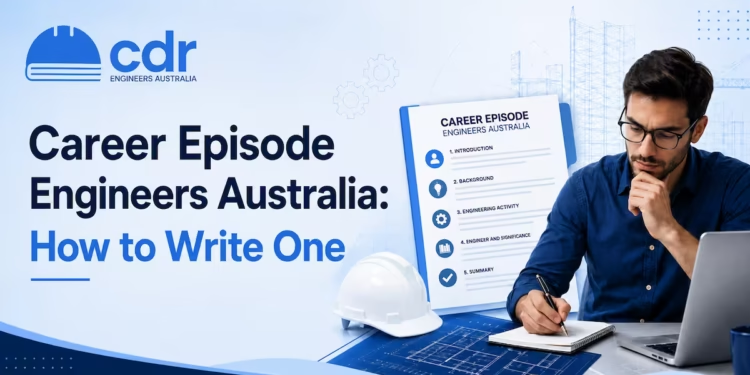


Every career episode that Engineers Australia receives lands on an assessor’s desk with one question attached: did you personally make engineering decisions, or did you stand near a project while your team made them? Assessors do not score your project. They score the evidence that you, individually, applied a defined set of competencies. That single shift, from writing for the template to writing for the competency standard, separates an approved submission from a rejected one. This guide shows you how to build each career episode Engineers Australia assessors read as a competency evidence case, with a worked stormwater example mapped to real element codes.
If you are still weighing whether your experience qualifies, work through the eligibility and pathway guide first. This article assumes your occupation is confirmed and you are ready to write.
What EA Assessors Actually Read For
Your Competency Demonstration Report holds three career episodes, one Summary Statement, and your CPD record. The episodes read as narrative. The Summary Statement reads as a lookup table: beside each competency element, you enter the exact numbered paragraph where you proved it. An assessor opens the Summary Statement first, then jumps straight to each cited paragraph to test the claim.
The mechanic most CDR guidance skips entirely: every paragraph in an episode is numbered so it can be traced. Cite paragraph 3.7 against PE1.2, and the assessor reads 3.7 for one thing only, an individual engineering decision that shows in-depth technical competence. Describe what the team delivered instead, and the element fails, even with the code sitting neatly in your Summary Statement. Each numbered paragraph is an exhibit, not a sentence.
A Professional Engineer must evidence 16 competency elements, grouped as PE1 Knowledge and Skill Base (PE1.1 to PE1.6, six elements), PE2 Engineering Application Ability (PE2.1 to PE2.4, four elements), and PE3 Professional and Personal Attributes (PE3.1 to PE3.6, six elements). The elements you will anchor paragraphs to most often:
Code | What the paragraph must show |
|---|---|
PE1.1 | You solved a problem from engineering and science first principles |
PE1.2 | In-depth technical competence in your discipline |
PE1.3 | Command of engineering techniques, analysis, and design tools |
PE2.1 | You identified and formulated the problem, with original analysis |
PE2.3 | A systems approach: risk quantified, alternatives weighed, optimal solution chosen |
PE2.4 | Design proficiency from requirements through verification |
PE3.1 | Awareness of professional, ethical, and legislative responsibilities |
PE3.2 | You communicated effectively in English to technical and non-technical readers |
PE3.5 | Evidence of ongoing professional development |
PE2 carries the fewest elements but the heaviest technical load, so its four elements are the ones weak drafts most often leave un-evidenced. Confirm the exact current wording for your occupation against EA’s own competency document before you cite anything, because the element descriptions differ between occupational categories.
Before You Write: Choose Projects and Confirm Your ANZSCO Code
Your ANZSCO occupation code is the anchor for everything that follows. It sets your category (Professional Engineer, Engineering Technologist, or Engineering Associate), and each category writes to its own element set. Look up your code, confirm the category, and cross-check it against the Engineers Australia skills assessment overview before you draft a single line. Two applicants with near-identical experience but different codes are held to different standards.
Then pick three projects that spread your evidence across distinct competency clusters. The three-episode rule exists to demonstrate breadth, not to give you three chances to repeat the same elements. Map each candidate project against the 16 elements and choose the combination that leaves nothing uncovered across the full CDR. One might carry your PE2 design elements. Another is where your PE3.1 ethical judgement surfaced. Treat the three episodes as a single portfolio with deliberate division of labour, not three separate stories chasing the same evidence.
The Four Sections Engineers Australia Requires
Each episode runs 1,000 to 2,500 words and follows four mandatory sections in order:
Introduction (around 100 words): dates, organisation, your title, the project name. Facts only.
Background (roughly 200 to 500 words): the project’s objective, scope, and your position in the reporting line. Set the scene, then stop.
Personal Engineering Activity, or PEA (approximately 500 to 1,000 words): the core, and where your competency evidence lives.
Summary (50 to 100 words): what you contributed and what you took from it.
The most common rejection cause is a boundary failure between Background and PEA. Background describes the project. The PEA describes your decisions. If your PEA still reads “the system was designed to handle peak flow,” you have written more Background. The assessor needs “I calculated the peak flow and selected the pipe size.”
Writing the Personal Engineering Activity Section
Structure the PEA as a run of numbered paragraphs that move from knowledge applied (PE1), through engineering process (PE2), to professional conduct (PE3). Aim for one competency cluster per paragraph rather than one sub-element per paragraph. Draft each paragraph with the element code written directly into it, a discipline that forces you to prove the element instead of asserting it. You will lift most codes out of the final narrative and formalise them in the Summary Statement, but keeping them in during drafting holds every paragraph accountable.
Watch the verbs. “I designed,” “I calculated,” “I identified,” and “I specified” pass. “We completed” and “the design was finalised” get flagged, because neither shows an individual engineering decision. First-person, active, singular, throughout.
Worked Example: A Stormwater Task Mapped to PE1.2 and PE2.3
Take one real task: sizing a stormwater drainage line for a subdivision.
Weak: “The team designed the stormwater drainage system to meet local council specifications.”
Strong: “I applied AS/NZS 3500.3 to calculate a peak flow of 42 L/s for the 100-year ARI event, then specified a DN300 pipe as the design solution, weighing hydraulic capacity against trench and installation cost [PE1.2, PE2.3].”
The weak version names no method, no number, no decision, and no engineer. The strong version shows in-depth technical competence (the standard applied, the calculation performed) for PE1.2, and a systems approach (risk quantified, cost trade-off made, solution selected) for PE2.3. One task, two elements, both auditable. That is how a career episode that Engineers Australia approves gets built, exhibit by exhibit. This rewrite is our own analysis derived from EA’s public framework, not a quote from any EA document.
Four Paragraph Patterns That Trigger an Adverse Assessment
1. Collective voice. “We” and “the team” running through the PEA. The assessor cannot isolate your contribution, so the element goes unproven.
2. Background bleeding into the PEA. Project description where engineering decisions belong. If a paragraph would survive unchanged had someone else done the work, it belongs in Background, not the PEA.
3. Assertion without process. “I designed an efficient system” states a result but hides the method. Show the calculation, the standard, the option you rejected and why.
4. No standards or methodology named. A PEA with no code, no named tool, and no calculation reads as a manager’s summary, not an engineer’s evidence.
Checking Your Career Episode Engineers Australia Against 2025 Rules
Before you submit, run each career episode through a self-check against four criteria:
Word count between 1,000 and 2,500, with the PEA as the longest section.
Every numbered paragraph traceable to at least one competency element, and every required element evidenced somewhere across your three episodes combined.
No “we” and no passive constructions in the PEA.
Every competence claim backed by a method, a number, or a named standard.
On the 2025 framework, proceed carefully. EA’s current competency standards document, available directly from the Engineers Australia website, is the authoritative source for element wording and occupational category assignments. Do not write to a second-hand summary from a CDR service page. If your ANZSCO code was recategorised under the current framework, the element set may have shifted, and a draft aligned to an older version will evidence the wrong standard.
The specificity test catches the remainder. Read each PEA sentence and ask whether a different engineer could have written it about a different project without changing a word. If yes, it is too vague to evidence anything. Add the number, the standard, or the decision that makes it specific to you and to this project.
After Your Career Episodes: The Summary Statement and CPD
The Summary Statement is where the audit happens. Treat it as the reason your paragraphs are numbered, not as a formality at the end. For each of the 16 elements, enter the episode and paragraph number that proves it. A blank cell is not a minor gap; it signals a coverage failure in the narrative that must be fixed before submission, not papered over in the Statement. Your CPD record then completes the picture, showing continued development against PE3.5. The CPD requirements guide sets out what qualifies and how to format it.
For a broader view of how your episodes, Summary Statement, and CPD fit into a complete submission, the ten-step CDR writing guide covers the full structure from opening to final review.
Questions Engineers Ask About Career Episodes
How long should each career episode be for Engineers Australia?
Between 1,000 and 2,500 words. Keep the Personal Engineering Activity section as the longest part, at roughly 500 to 1,000 words, and hold the Introduction near 100 words with the Summary between 50 and 100.
Can I write two career episodes about the same project?
Yes, provided each episode evidences different competency elements and describes distinct engineering activity. Two episodes on one project only work when they cover genuinely separate technical decisions. If they would repeat the same evidence, choose a second project instead to demonstrate breadth.
Does Engineers Australia require career episodes in chronological order?
No. Order them however presents your competency evidence most clearly. Assessors read for element coverage, not timeline, so lead with the episode that carries your strongest engineering decisions.
What tense should I use in my career episode?
Past tense for the work you did (“I designed,” “I calculated”), because career episodes describe completed engineering activity. Keep the voice first-person and active throughout the Personal Engineering Activity section.
How many competency elements do I need to address in each career episode?
There is no fixed per-episode number. All 16 Professional Engineer elements must be evidenced across your three episodes combined. A single strong episode commonly covers six to ten elements, so plan the three together to ensure none is left unaddressed.
What happens if my career episode exceeds 2,500 words?
It falls outside EA’s stated range and risks being returned before assessment. If you run long, cut Background and any project description that does not show your decisions, rather than trimming genuine PEA evidence. Excess length almost always traces to too much context, not too much competency evidence.
Your career episodes can be technically strong and still fail on a pattern you never noticed. Read the CDR mistakes guide to see the exact errors that blocked real applications, and confirm your career episodes do not repeat them.