

You have a draft sitting in a folder, an Engineers Australia deadline pinned to a visa timeline, and two browser tabs open: one selling a CDR writing service, the other offering expert review of what you have already written. Both promise to protect your skills assessment. Only one fits your situation, and choosing wrong costs you either money you never needed to spend or a rejection you could have prevented.
This is a genuine two-path decision, not a pitch for either service. Three things determine the right answer: whether you hold a complete draft you wrote yourself, how confident you are documenting engineering work in technical English, and how many weeks sit between you and your assessment deadline.
What you are actually deciding when you search for CDR help
Ask one binary question first: do you have a finished, self-authored CDR, or do you have engineering experience and a blank page?
A blank page, or a few disconnected paragraphs, means you are shopping for writing. Three complete Career Episodes, a CPD list, and a Summary Statement that you drafted and now doubt mean you are shopping for review. Almost every wasted dollar in this decision comes from engineers who answer that question loosely, then pay for the wrong service.
One filter before you spend anything: not every engineer needs a CDR at all. Engineers whose degrees were accredited under the Washington Accord are exempt only when three conditions are met simultaneously: the degree was awarded by an institution in a full signatory country at the time of graduation, the specific program fell within the accredited date range, and accreditation was full rather than provisional. That exemption is narrower than most applicants assume. If you are unsure whether you fall inside it, start with who actually needs to apply.
What each service delivers before you pay for it
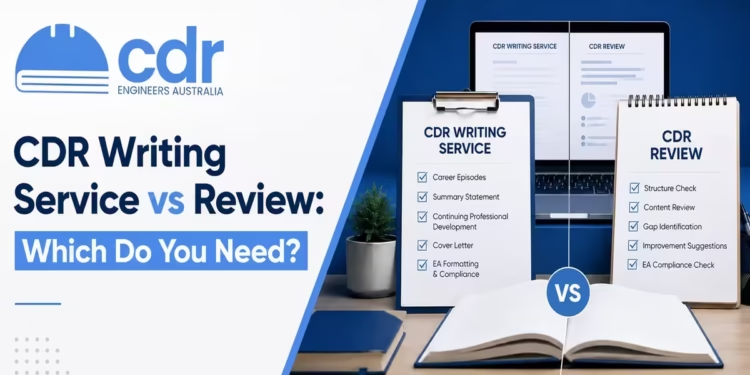
Writing service: all three CDR documents built from your engineering history
A CDR writing service builds the full submission from your raw career history: three Career Episodes of 1,000 to 2,500 words each, a Continuing Professional Development (CPD) list, and a Summary Statement that maps your demonstrated skills to every competency element Engineers Australia requires. For a full breakdown of what each document must do, the 2026 CDR complete guide covers the structural requirements in detail. You supply project details, employment records, and your nominated occupation; the writer produces documents structured to EA’s guidelines. You are paying for authorship and competency mapping, not proofreading.
Review service: a competency audit of the draft you have already written
A review service does not write. It audits. A reviewer reads your existing Career Episodes and Summary Statement against EA’s skills assessment criteria and flags where the evidence falls short: a Career Episode that narrates what the team delivered instead of what you personally engineered, or a Summary Statement that claims a competency your episodes never actually demonstrate. Those two failures are the most-cited reasons EA sends a CDR back, and a good review exists to catch them before an assessor does. You are paying for judgment on work that already exists, not for the work itself.
Cost, turnaround, and rejection risk compared
Competitor pages quote a service fee and stop there. The number that actually decides this is the total cost-of-outcome: what you pay to submit, plus what a rejection would cost on top.
Start with the fixed figure. Engineers Australia’s standard CDR assessment fee is AUD 1,034 including GST from 1 July 2026. Every path below carries that same EA fee, so the service cost and the rejection risk are what separate them. For the full schedule, see the 2026 EA fees breakdown.
Writing path. A service fee of roughly AUD 600 to 1,500, plus the AUD 1,034 EA fee, lands you at about AUD 1,634 to 2,534 all in, submitted once.
Review path, if the draft passes. A review fee of roughly AUD 200 to 500, plus AUD 1,034, comes to about AUD 1,234 to 1,534. Cheaper, clearly. If your draft is genuinely sound, this is the efficient choice.
Review path, if the draft is rejected. Here the math turns. On a standard unsuccessful outcome, you are looking at an EA review request fee of AUD 357.50 or a formal appeal at AUD 682, a reactivation admin fee near AUD 132, and for a substantially reworked resubmission, frequently a fresh full assessment fee of AUD 1,034. Stack those onto your original review spend, and the worst case runs past AUD 3,000, more than the writing path would have cost.
That is the real trade. Review is cheaper when it works and expensive when it does not. The writing path costs more up front and removes most of the downside.
On timing, the two services are not close. A CDR writing service typically takes 10 to 18 business days; review runs 3 to 7. Both are fast against Engineers Australia itself, where standard CDR processing runs 10 to 16 weeks. One planning trap to avoid: fast-track (an EA surcharge of AUD 396 from July 2026) does not buy a decision in ten business days. It means an assessor is assigned within 20 business days, with total processing around 4 to 6 weeks. Work backwards from your visa date using 4 to 6 weeks at best before choosing standard or fast-track processing.
CDR writing service: best for engineers starting without a usable draft
Picture an engineer with ten years of solid site experience whose written technical English is a genuine weak point. The engineering record is real; the ability to narrate it in the first person, in EA’s competency language, across 4,500-plus words, is not there yet.
For this engineer, a review is the wrong purchase, because there is nothing sound to review. A reviewer would return a page of corrections that amount to “rewrite this,” and the engineer would still face the blank page, now on a shorter clock. A CDR writing service converts that same career into episodes that isolate individual contribution and a Summary Statement whose competency claims trace back to episode evidence, exactly where weak self-drafts get rejected. When the constraint is documentation rather than engineering depth, paying for authorship removes more rejection risk than any amount of reviewing a shaky draft ever could. The most common EA rejection mistakes are worth reading either way, since preventing them is precisely what a professional writer is built to do.
For a closer look at what structurally strong Career Episodes require, the career episode guide walks through each section.
CDR review service: best for engineers with a complete but uncertain draft
Now a different engineer: strong written English, three finished Career Episodes, a Summary Statement, and a colleague who has been through the EA process, read the draft, and called it close. What is missing is not writing ability but an assessor’s-eye check on competency mapping.
Paying for a full writing service here wastes money and discards work that is already most of the way there. A reviewer confirms each competency element is evidenced, tightens first-person contribution in any episode that drifts toward team narration, and checks that the Summary Statement cross-references hold. When you already have a complete draft and independent signal that it is close, review is the proportionate spend. One caution changes this calculation, and that caution comes in the next section.
Writing then review: when using both services cuts rejection risk
There is a third path competitor pages never name: have the CDR written, then have it independently reviewed by a different provider before you submit. The cost is the writing fee plus the review fee plus the EA assessment, roughly AUD 1,834 to 3,034 depending on where the service fees land.
That looks expensive next to a bare review, until you set it beside the rejection scenario above, where a failed cheap review can push total spend past AUD 3,000 anyway, with weeks lost. For engineers in occupations with above-average rejection rates, or anyone whose visa timeline leaves no room for a resubmission cycle, buying a second independent set of eyes is cheaper than funding a second assessment.
One risk makes this path especially relevant. Engineers Australia now runs advanced AI-detection software on submissions, and AI-generated content can trigger a 12-month ban on reapplying or a Public Interest Criterion PIC 4020 fraud investigation. That outcome is a different animal from a routine unsuccessful assessment. If you self-drafted with AI assistance and then buy review only, a reviewer polishing your text does not remove that detection exposure. A professionally authored CDR, then independently reviewed, carries lower AI-detection risk than a polished self-draft. Keep the distinction precise: a standard rejection means correct and resubmit; an AI or fraud finding means a ban.
No service, writing or review, can guarantee an Engineers Australia approval, and any provider advertising a “100% success rate” or a “pass guarantee” is describing marketing, not an outcome EA has ever promised anyone. Treat guarantee language as a reason for scrutiny, not comfort. What you actually buy is lower rejection probability, and that is worth paying for on its own terms.
Questions engineers ask before choosing a CDR service
Can I get a review if I only have a rough draft?
Not usefully. Review audits finished work against EA criteria, so a rough draft gives a reviewer too little to assess and you receive corrections that amount to “write this properly.” Fragments and incomplete sections need writing, not review. Once you hold three complete Career Episodes and a Summary Statement, review becomes the right tool.
What if Engineers Australia rejects my CDR after a paid review?
It depends on which kind of rejection. A standard unsuccessful outcome means you correct the flagged issues and resubmit, submitting an EA review request at AUD 357.50 or an appeal at AUD 682, plus a reactivation admin fee near AUD 132 and often a fresh assessment fee of AUD 1,034. An AI-detection or fraud finding is different and far worse: a 12-month reapplication ban or a PIC 4020 investigation. A review reduces the odds of the first; only honest, professionally authored content protects against the second.
How long does each service take against a typical EA deadline?
Writing runs about 10 to 18 business days; review about 3 to 7. Engineers Australia itself takes 10 to 16 weeks on the standard CDR pathway, or roughly 4 to 6 weeks on fast-track (assessor assigned within 20 business days, not a ten-day decision). Add the service time to EA’s processing time, then compare the total against your visa deadline before choosing standard or fast-track processing.
How much more does a CDR writing service cost compared to a review, and does the difference justify the price?
At first glance, writing costs AUD 400 to 1,300 more than review upfront. Whether that gap is justified depends entirely on whether your draft would pass. A review on a strong draft is efficient; a review on a weak draft that gets rejected turns the cheaper option into the most expensive one. If you are weighing an AUD 300 review saving against an AUD 1,500-plus resubmission cycle, the writing path is the lower-risk investment, not the more expensive one.
Is a write-then-review approach worth the extra cost?
If a rejection would break your visa timeline, or you are in a higher-rejection occupation, yes. The combined fee sits below the cost of a failed submission plus resubmission, and the second independent review catches competency-mapping gaps that cause most returns. If your draft is already strong and independently vetted, the sequence is overkill and a single review is enough.
Not sure which service fits your situation? Request a free CDR evaluation and get a specific recommendation before you spend anything.