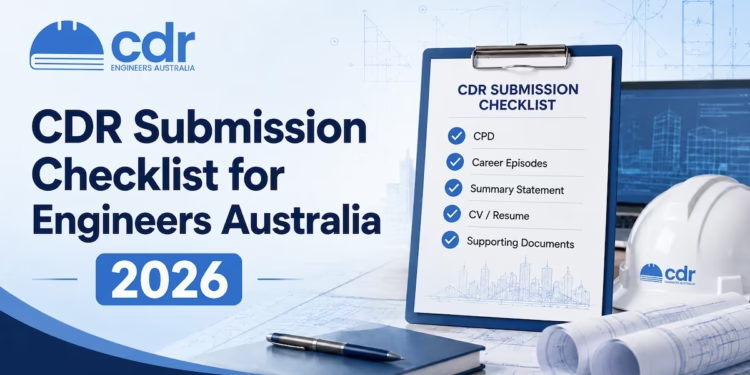


Your draft is finished, the payment page is loaded, and the next click commits you to an assessment you cannot recall. Work through this CDR submission checklist before you pay. It covers the same ground your Engineers Australia assessor does, and because every test below maps to a criterion in EA’s Migration Skills Assessment booklet, it catches the errors that produce an unsuccessful outcome, not just the typos a proofread would flag.
What an unsuccessful assessment actually costs
According to EA’s published fee schedule, the standard Migration Skills Assessment fee rose to around AUD 1,034 including GST from 1 July 2026, up from approximately AUD 1,001 the previous year. That money is non-refundable. An unsuccessful result does not earn you a discounted retry: you pay the full fee again and rejoin the queue behind everyone who applied while you were revising.
The calendar hurts more than the invoice. A resubmission can push your skills assessment back by weeks or months, and if your visa pathway has a points deadline or an expiring English test result, that delay cascades into the parts of your migration you cannot control. A structured self-review is the single most valuable hour in the whole process, because it is the only stage where fixing a fault costs you nothing.
What to have open before you start
Two documents, nothing else. First, download EA’s current Migration Skills Assessment (MSA) booklet from the Engineers Australia website. Every criterion your assessor applies is drawn from it, so it is your benchmark, not this article and not any competitor’s tip list. Second, confirm your nominated ANZSCO occupation code and the competency unit list attached to it. That code decides which competency standard you are assessed against, and getting it wrong invalidates the mapping work in Step 2 before you even begin.
Step 1: Audit each career episode for length and voice
Open each of your three career episodes and check the word count in isolation. The MSA booklet sets each episode at 1,000 to 2,500 words. Under 1,000 reads as thin evidence; over 2,500 invites the assessor to wonder what you are padding. Inside that total, balance matters too: a tight introduction, a short background, then the bulk of your words on your personal engineering activity, and a brief closing summary. If your 2,300 words are mostly background with a thin slice of your own work, the episode fails its purpose even at a legal length.
Third-person passages read as a ghostwriting signal
Every career episode must be written entirely in the first person: I designed, I calculated, I resolved. EA assessors are trained to treat third-person narration (“the team developed”, “the engineer was responsible for”) as evidence the applicant did not write the report themselves. This is where borrowed paragraphs betray you, because copied text almost always carries the wrong voice. Read each episode aloud and flag every sentence where the “I” disappears.
Step 2: Map your Summary Statement to the right elements
Picture the assessor with your Summary Statement open beside your episodes, checking that every competency element points to a real paragraph. That cross-reference is the spine of your submission, and it breaks in two predictable ways.
Start with the template. The competency elements are not universal. Professional Engineers demonstrate 16 elements across three categories: Knowledge and Skill Base (PE1.1 to PE1.6), Engineering Application Ability (PE2.1 to PE2.4), and Professional and Personal Attributes (PE3.1 to PE3.6). Engineering Technologists, Engineering Associates, and Engineering Managers each use a different prefix and a different element set. Before you review a single mapping, confirm your occupational category and download EA’s category-specific Summary Statement template. If you should be an ET and you map the 16 PE elements instead, every code in your document is wrong.
Where the paragraph referencing goes wrong
Your Summary Statement must cite specific numbered paragraphs using EA’s notation, CE1.1, CE1.2, CE2.1 and so on, tying each competency element to the exact paragraph that demonstrates it. Number your episode paragraphs first, then map. The common failure is a vague reference (“see Career Episode 1”) or an element left with no paragraph at all. A single unmapped element is enough for an unsuccessful outcome, so run down the full list for your category and confirm each one resolves to a real, numbered location.
Step 3: Run the similarity and AI check before EA does
This step carries the heaviest penalty, so treat it seriously. Engineers Australia runs every submission through Turnitin, which now flags both text-matched similarity and AI-generated content. A draft that trips either check does not simply get marked down.
The consequence runs in three parts. You receive an unsuccessful outcome and forfeit the fee. You can be banned from reapplying for 12 to 36 months. And EA may refer the matter to the Department of Home Affairs, which reaches past your skills assessment and into the visa itself. Most checklists mention the first part and skip the rest. For a migration applicant, the referral is the leg that should worry you most.
EA has not published a specific similarity percentage, and the thresholds circulating on service-provider blogs (0%, 5%, 10%) trace back to no verifiable EA source, so ignore them. Run your draft through a similarity checker and a separate AI-detection tool before you submit, then rewrite any matched passage in your own words. If you drafted with an AI assistant, assume Turnitin’s AI module will notice, and revise until the writing is genuinely yours.
Step 4: Read for a non-specialist assessor
Your assessor is an engineer, but not necessarily in your discipline, and confidence in your CDR erodes fast when sentences are hard to parse. Do not mistake a technically dense passage for a clear one: if your assessor must reread a sentence, it is broken regardless of whether the underlying engineering is correct.
Watch for the patterns that recur in CDRs by second-language authors: dropped articles, subject-verb disagreement, tense that shifts inside a single episode, and run-on sentences that fuse three actions into one. None of these change your competence. All of them lower the assessor’s confidence. Grammar tools help you spot the obvious cases, but read each episode once more slowly, the way your assessor will, sentence by sentence.
Step 5: Confirm your documents meet verification standards
A flawless narrative still fails if a supporting document is rejected at verification, and two requirements catch international applicants most often.
Any non-English document, whether a degree, a transcript, or an employment reference, must arrive with a certified translation from a NAATI-accredited translator. An uncertified translation, even an accurate one, is rejected at the document verification stage. Your scans must also be fresh, high-resolution color images at 300 dpi or above; black-and-white scans and scans of photocopies are thrown out. Employment letters must show letterhead, your dates, role, and duties in a format EA verifiers expect. Our document checklist covers the full list, so cross-check yours against it rather than trusting memory.
Step 6: Audit your CPD list for limit and recency
Start with the hard constraint: your Continuing Professional Development list must fit on a single A4 page. Not two, not a page with a spillover line. If yours runs over, trim it before anything else, because length alone can undermine an otherwise valid list.
EA accepts genuine professional development: formal courses, conferences, technical short courses, private study, and relevant workplace learning. Certificates are not required, but the activities must be real. If your recent record is thin because you were between roles or heads-down on delivery, present what you have honestly, with dates and hours, rather than inflating it. A padded CPD list is easier to spot than a modest genuine one, and it undercuts the integrity the rest of your CDR is trying to establish.
CDR self-review scoring matrix
Run each component through one binary test. Any fail means fix it before you submit, not after.
| Component | Pass / fail test |
|---|---|
| Each career episode | 1,000 to 2,500 words and written entirely in the first person |
| Summary Statement | Correct category template, every element mapped to a numbered CEx.x paragraph |
| Similarity | No matched passage left unrewritten |
| AI detection | Writing is genuinely your own, not model-generated |
| Language quality | Every sentence is clear on a single read |
| Supporting documents | NAATI-certified translations and 300 dpi color scans |
| CPD list | Fits on one A4 page |
If every row passes, your CDR submission checklist is complete and the risks you can control are handled. Fix any row that fails before you pay: it is a cheap correction now and an expensive resubmission later.
Three problems engineers miss until the result arrives
The wrong Summary Statement template is the quietest killer. An engineer applying as an Engineering Technologist who reuses the 16 PE codes has mislabelled every element, and no amount of good writing rescues a mapping built on the wrong standard.
The second is a career episode that hits its word count while starving the part that matters. An episode heavy on project background and light on your own engineering activity clears the length test and still fails the evidence test.
The third is AI-assisted drafting. A polished paragraph generated by a model can pass a human read and still trip Turnitin’s AI module, and by then the fee is gone. For the wider list of what sinks a submission, our CDR mistakes guide maps the full taxonomy.
Frequently asked questions about the CDR submission checklist
How many of EA’s 16 competency elements must each career episode address?
There is no fixed per-episode quota. Across your three episodes combined, every competency element for your occupational category must be demonstrated at least once and cited in the Summary Statement. Some episodes naturally carry more elements than others, so the test is coverage across the set, not a matching count in each episode.
What happens if Engineers Australia detects a high similarity score in my CDR draft?
You receive an unsuccessful outcome and forfeit the non-refundable fee. Beyond that, EA can ban you from reapplying for 12 to 36 months and may refer the matter to the Department of Home Affairs, which can affect your visa itself. This is why the similarity and AI check is the step to take most seriously.
Can I reuse the same career episode under a different ANZSCO occupation category?
Not directly. A different occupation is assessed against a different competency element set, so an episode written to demonstrate PE elements will leave ET, EA, or EM elements unmapped. You can reuse the underlying engineering experience, but you must re-map it against the correct template and often re-emphasise different aspects of the same project.
How long should the self-review process take before CDR submission?
Budget a full day, and closer to two if you find real problems. A genuine review means reading three episodes aloud for voice, running a similarity and AI scan, checking every Summary Statement reference, and verifying documents. Skimming for an hour builds confidence rather than catching errors, and confidence is a poor substitute for the fee you will lose if a problem slips through.
Does Engineers Australia return CDRs for revision, or does a problem result in an outright unsuccessful outcome?
EA may raise a query on a minor point in some cases, but a substantive fault, such as an unmapped element, above-threshold similarity, or third-person narration, typically produces an unsuccessful outcome rather than an invitation to revise. Do not build your plan around a second chance you may not get.
What career episode word count is too short for Engineers Australia to accept?
Anything below 1,000 words. That is the MSA booklet floor for each episode, and a shorter one reads as insufficient evidence of your engineering role. If an episode falls short, the fix is more detail on what you personally did and decided, never filler about the project’s background.
Before you submit, confirm your report’s structure matches EA’s format requirements: read our complete CDR Report Format guide for Engineers Australia.