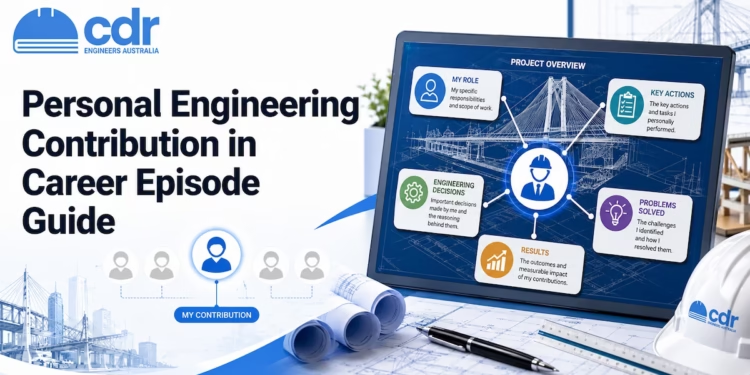


Your personal engineering contribution in career episode writing is the single thing an Engineers Australia assessor is trained to locate, and it is the thing most returned CDRs fail to show. You worked on a substation, a bridge deck, a control system, a reporting platform. The project shipped. But the assessor is not scoring the project. They score what you specifically calculated, specified, analysed, or decided. This guide shows you how to pull that individual work out of a team deliverable and write it so an assessor can follow it line by line. It assumes you already know the general CDR structure; this page goes deep on the one section that decides most outcomes.
What Personal Engineering Activity Means in EA Assessment
Engineers Australia’s July 2025 career episodes and summary statement guide is explicit on one point: each career episode must describe your own engineering work, not the project’s collective output. The Personal Engineering Activity is a distinct, required section inside every episode, not a matter of style. It is where you demonstrate competency, and Engineers Australia weights it accordingly.
Across published format guidance, a full career episode runs 1,000 to 2,500 words, and the Personal Engineering Activity itself typically occupies 600 to 1,500 of them. That length exists for a reason: the assessor needs enough resolution to see individual decisions, not a summary.
The trap is describing the project well and yourself barely at all. “The team upgraded the SCADA network across six pump stations” is a fine project sentence and useless as competency evidence. It tells the assessor nothing about your engineering. A career episode covers a single, bounded piece of work, and within that boundary the assessor is hunting for you.
What to Gather Before You Write a Sentence
Before drafting, pull two things.
First, your task-level record from the project, not the project summary. Dig out your own calculation sheets, the specifications under your name, the review comments you wrote, the inspection findings attributed to you. These are the raw material of a defensible episode. If your only record is the project scope, you will end up writing about the team.
Second, the competency elements for your nominated occupation. Overseas engineers apply under one of three categories: Professional Engineer (PE), Engineering Technologist (ET), and Engineering Associate (EngAssoc). The Migration Skills Assessment (MSA) competency framework uses a W-series structure, W1 through W7, to organise the indicators assessors mark against. PE applicants write to the Stage 1 standard underpinning those indicators; ET and EngAssoc applicants write to the corresponding Stage 2 standard. You are writing to those elements whether you name them or not, so read them first. Our skills assessment criteria overview breaks the categories down.
Step 1: Separate Your Actions From the Team’s Output
Most overseas applicants stall here because they cannot tell which of their daily tasks actually count. Sort every task into one of two columns.
Personal engineering activity | Coordination and support |
|---|---|
Load, bearing, or heat calculations you ran | Attending project status meetings |
Specifications and design documents you authored | Distributing drawings to the team |
Technical analysis that produced your findings | Reporting progress to the project manager |
Site inspections generating findings attributed to you | Arranging site access |
Design or code reviews you authored, with your comments | Taking minutes |
The left column is competency evidence. The right column, however necessary to the job, demonstrates no engineering ability and belongs in the Background at most.
One structural detail makes the isolation non-negotiable. Every paragraph in a career episode is numbered (1.1, 1.2, 1.3 in the first episode, 2.1 onward in the second), and your Summary Statement cites those exact numbers against specific competency elements. Each numbered paragraph is a chain-of-custody link between a claim and its evidence. If paragraph 1.7 blends three people’s work, the assessor cannot cite it cleanly, and a paragraph they cannot cite does not score.
Step 2: Rewrite Team Language as First-Person Action
Every ranked guide tells you to write in the first person and shows the same fix: passive to active. Real applicants do not start from passive voice. They start from “we”. Here is the harder rewrite, across three disciplines.
Instrumentation. “We designed the control system for the pump station” becomes: “I specified the PLC logic for the pump control system, selecting the Siemens S7-1200 based on the I/O count I mapped from the P&ID.” The assessor now sees a device you chose and the engineering basis for choosing it.
Structural. “We designed the foundations” becomes: “I calculated the bearing capacity to AS 2159-2009 and specified a 600 mm diameter bored pier at 12 m depth for the transformer plinth.” A standard, a dimension, a decision you can defend.
Analytical. “We built the reporting module” becomes: “I designed the database schema for the reporting module, normalising it to third normal form to remove the update anomalies I found in the legacy flat-file export.” This rewrite matters for consulting and operations engineers who exercised real technical judgment without leading a physical design.
Notice what changed across all three. Each rewrite replaces a role description with an action statement. “I was responsible for foundation design” names a duty and proves nothing. “I calculated bearing capacity to AS 2159-2009 and specified a 600 mm bored pier at 12 m depth” shows what you personally computed and decided. That single shift is the most common revision in returned CDRs, and it is the one the thin commercial service pages never actually demonstrate.
You can keep project context without sliding back into team voice. Open the sentence with the shared setting, then resolve it to your action: “Working within a four-engineer design team, I sized the structural steel beams to AS 4100 for the 9 m mezzanine span.” The context frames; the verb belongs to you.
Step 3: Quantify Your Scope Without Overstating It
Numbers make a personal contribution credible, and the honest ones are about scope, not glory. State the pier depth, the span, the fault level, the dataset size, the tolerance you held. These anchor your work at the level you actually operated.
Team size and project value belong here too, but as working context, not personal achievement. “I was one of four design engineers on a $40 million rail upgrade” tells the assessor the scale you worked at without claiming you delivered the whole program. The distinction matters. Inflating a shared outcome into a personal one is the fastest way to fail an authenticity check, and Engineers Australia runs plagiarism and cross-application detection on every submission, so a fabricated scope carries real risk with no upside.
Step 4: Map Each Contribution to an EA Competency Element
Assessors do not reward good sentences in the abstract. They match your paragraphs to specific elements of the MSA competency framework, so write knowing the target. The W-series indicators sit behind every assessment category; for PE applicants, the most relevant Stage 1 elements for common engineering tasks are:
What you did | EA element |
|---|---|
Framed the technical problem and stated your assumptions | PE2.1a |
Identified design concepts and proposed the optimal solution | PE2.4c05 |
Specified equipment and operating arrangements | PE2.4c08 |
Made a key design contribution as a team member | PE2.4d |
Delivered a project outcome with key contribution in a team | PE2.5a |
PE2.4d and PE2.5a settle the question every team-based applicant asks. Both elements explicitly accept experience as a team member with a demonstrated key contribution, rather than requiring you to have led a full design alone. Teamwork is not a weakness in the framework; unevidenced teamwork is.
The underlying competency assessors are testing throughout is independent engineering judgment: the capacity to make and defend a technical decision among alternatives. The PE2.1a and PE2.4 series test whether you exercised it. Map your contributions deliberately, but keep the element codes in your Summary Statement where they belong. The career episode should read as engineering prose that satisfies the criteria, not a list of tagged sentences.
Step 5: Test Your Career Episode for Hidden Contribution Gaps
Three sentence patterns hide your role even when you meant to show it: the team subject (“The team commissioned the switchboard”), the vague duty (“I was involved in the commissioning”), and the credit-free passive (“The switchboard was commissioned”). All three pass a casual read and fail an assessor.
Run every Personal Engineering Activity paragraph through five checks as you draft, not only before you submit:
1. Subject: is the grammatical subject “I”? If it is “we”, the team, or the project, rewrite.
2. Verb: is the verb a specific engineering action (calculated, sized, specified, analysed) rather than a coordination verb (assisted, participated, was involved in)?
3. Basis: does the sentence name the standard, parameter, or reasoning behind the decision?
4. Judgment: does it show a choice you made among alternatives?
5. Traceability: could this numbered paragraph be cited in the Summary Statement against one named competency element?
A paragraph that clears all five is citable evidence. One that fails any is a gap an assessor will find before you do.
When Assessors Return a Career Episode for Weak Personal Contribution
The recurring pattern in returned episodes is the same: the assessor could not identify your individual engineering role. Design-light episodes draw this outcome most often, because Engineers Australia weighs personal design contribution heavily and flags its absence.
You do not need to start over. Locate the thin paragraphs first: any that open with “we” or “the team”, and any that describe a responsibility without an action. Convert each using Step 2, add the standard or parameter that was missing, and confirm the Summary Statement now points to a real action rather than a duty. Most returned episodes need targeted revision on a dozen sentences, not a rewrite from scratch. Our guide to common CDR mistakes covers the errors that trigger a return in the first place.
Common Questions About Demonstrating Personal Engineering Contributions
What exactly counts as a personal engineering activity in a career episode?
Any engineering task you personally performed that produced a technical output: a calculation you ran, a specification you wrote, an analysis that generated your findings, a design decision you made and can defend. Coordination tasks like attending meetings or distributing documents do not count, however essential they were to the project.
How do I show my personal contribution when I worked on a large team project?
Isolate your specific actions and write each as a first-person action statement with its engineering basis. Engineers Australia’s framework supports you here: PE2.4d and PE2.5a of the Stage 1 standard explicitly accept a demonstrated key contribution within a team as valid evidence. Name the scale you worked at, then resolve every sentence to what you did within it.
Can I use “we” at all in a career episode, or must every sentence use “I”?
“We” is acceptable in the Background section to describe the team’s collective scope. In the Personal Engineering Activity section, every sentence must resolve to a first-person action you performed. A sentence may open with team context, but it must close on your specific engineering action.
How many individual contributions do I need to describe in each career episode?
There is no fixed count. Fill the 600 to 1,500 words of the Personal Engineering Activity section with discrete, numbered engineering actions, each traceable to a competency element. Depth on a few substantial contributions outweighs a long list of shallow ones.
What do assessors do when they cannot identify my personal role in a career episode?
They return the CDR as unsuccessful or request a revised episode, citing insufficient personal engineering contribution. Revision means converting the flagged role descriptions and team-language sentences into action statements; you rarely need to rewrite the episode from scratch.
To see where your personal engineering contribution in career episode writing fits inside the full Engineers Australia assessment, read our complete CDR guide and map this section onto the rest of your submission.