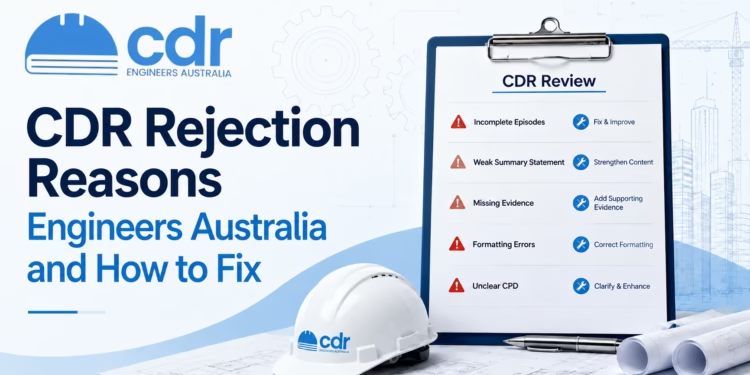


Search the CDR rejection reasons Engineers Australia applicants keep hitting, and every result hands you the same thing: a flat list of twenty warnings, no priority, no diagnosis, no way to tell which one actually sank your assessment. That list cannot help you resubmit. An Unsuitable outcome names one specific criterion the assessor scored as unmet, and until you know which one, you are guessing with a fee of AUD 1,034 on the table.
This guide draws the distinction the SERP refuses to make: the rejection reasons Engineers Australia assessors actually record are typed, not a random pile. There are six of them; each violates a named competency criterion, and each has a narrow fix. Below you get the six modes, a self-audit matrix to run against your own documents before you pay anything, and a decision framework for choosing between a resubmission and a formal review.
How Engineers Australia Scores a CDR Before Issuing an Outcome
Engineers Australia returns one of three outcomes, and the gap between them decides whether you owe another thousand dollars or nothing at all. Suitable confirms your competency. Unsuitable is the only true rejection: it closes the application, and reopening the pathway means a completely new submission with a fresh assessment fee. Further Information Required (FIR) sits between them and is the single most misread outcome on the pathway.
What triggers FIR versus an Unsuitable decision
FIR is a request for clarification inside your existing application, with no new fee, usually because the assessor needs one document, one employment date, or one reference confirmed before deciding. Unsuitable is triggered when the evidence itself fails the criterion: competencies unproven, occupation mismatched, or authorship in doubt. The financial line is sharp. FIR costs you a response and some time. Unsuitable, under Engineers Australia’s fee schedule effective 1 July 2026, costs AUD 1,034 for the new assessment plus an administration fee of approximately AUD 132, a combined total of over AUD 1,160 before you count the original fee already spent. If your outcome letter says Further Information Required, do not resubmit and do not pay again. Answer the question.
The three documents assessors score, and the order they open them
A CDR consists of three Career Episodes, a Summary Statement, and a CPD list, but assessors do not read it front to back. The Summary Statement is the entry point, working like an index at the front of a technical manual: the assessor jumps from each competency claim to the exact Career Episode paragraph you cite, then checks whether that paragraph proves it. Each Career Episode runs 1,000 to 2,500 words, and the CPD listing must fit one A4 page. Miss the Summary Statement’s structure, and the assessor never reaches your strongest evidence, even when it sits three paragraphs away. The format specifics live in our CDR report format guide; this article assumes you have them right and diagnoses what fails underneath.
How Career Episodes map to Washington Accord competency elements
Every claim is scored against the Stage 1 competency framework. The elements group into PE1 Knowledge and Skill Base, PE2 Engineering Application Ability, and PE3 Professional and Personal Attributes. PE3 alone carries six sub-elements, from PE3.1 ethical conduct through PE3.6 team membership and leadership. Career Episodes are not graded on how impressive the project was; they are graded on whether your personal actions evidence each element. “The team designed the system” proves nothing about you. “I calculated the load, selected the member, and verified the deflection” evidences PE2. The full criterion set is broken down in our CDR skills assessment criteria guide.
Six Typed Failure Modes: CDR Rejection Reasons Engineers Australia
Nearly every Unsuitable outcome traces to one of six modes, each mapping to a criterion the assessor scored as deficient. Naming that criterion is the whole game: it tells you what to fix and, just as important, what to leave alone.
Competency element gaps that leave PE1 and PE2 unproven
This is the most common failure mode and the most misdiagnosed. Across three Career Episodes, you must evidence the full spread of PE1 and PE2 elements, plus the PE3 attributes. Many applicants over-invest in one strong episode and leave whole elements unevidenced anywhere in the set. The assessor is not looking for a fourth impressive project; they are looking for the missing element. If PE2.2, fluent application of engineering techniques, never appears in first person, the box stays empty regardless of how good the rest is. The criterion it fails: incomplete PE1/PE2 coverage across the document set.
Plagiarism and authorship flags
Every Career Episode and Summary Statement is screened through Turnitin, or equivalent detection software, against a global database of published work, previously submitted CDRs, and online templates. Two things trip it: copied sample text, and episodes written by a third party, which Engineers Australia classifies as a plagiarism breach in itself. Both fail PE3.1 (the ethical conduct element), and neither carries a mild consequence. A confirmed finding results in an assessment ban of 12, 24, or 36 months depending on severity, and Engineers Australia may report the applicant to the Department of Home Affairs. No other failure mode can end your migration timeline for three years. Treat authorship authenticity as non-negotiable.
Occupation-to-experience mismatch against the ANZSCO code
A Suitable outcome requires your evidenced duties to match the ANZSCO description of your nominated occupation. Mismatch fails PE1 knowledge-base alignment: the knowledge you demonstrate belongs to a different occupation than the one you nominated. Two patterns recur across disciplines. Site-supervision and contractor-coordination evidence submitted under a Professional Engineer code often reads as Engineering Technologist work. Separately, nominating the broad 233999 Engineering Professionals nec code when a specific discipline code exists, such as 233512 Mechanical Engineer or 233311 Electrical Engineer, creates a mismatch the episodes cannot resolve. Confirm your nominated code against the current ANZSCO description before you assume the episodes are the problem.
Insufficient work duration or recency
Here the episodes may be technically sound, but the employment evidence behind them is thin: dates that do not add up, roles that your reference letters fail to confirm, or contributions described so generically that the assessor cannot attribute the work to you individually. This failure is documentary rather than technical, which matters because the fix is a paperwork correction, not a narrative rewrite.
Format and structural non-compliance
Career Episodes outside the 1,000 to 2,500 word range, broken paragraph numbering, a CPD list spilling past one A4 page, or documents submitted out of order all fall here. Format failure is the cheapest mistake to make and the cheapest to correct, yet a format error introduced during a content revision is a leading reason a second submission still fails. Lock the structure against the career episode format requirements after every content edit, not before.
Vague Summary Statement claims that cannot be cross-referenced
The Summary Statement is the assessors’ navigation tool, so a broken one can sink the whole CDR even when the episodes hold strong evidence. This fails PE2 cross-reference traceability. The contrast below shows exactly why.
Vague, and unscoreable: “In Career Episode 2, I demonstrated strong analytical skills on the water treatment project, applying engineering knowledge to solve complex problems.”
Correct, and traceable: “PE2.1: Career Episode 2, paragraph 2.14. I performed the hydraulic head-loss calculation for the 12 ML/day clarifier and selected the pump duty point from the resulting system curve.”
The second version names the sub-element, the episode, the exact paragraph, and the specific engineering action. An assessor confirms it in ten seconds. The first version sends them hunting, and a claim the assessor cannot verify is a claim scored as absent.
Reading Your Outcome Letter Before You Resubmit Anything
The outcome letter is where the CDR rejection reasons Engineers Australia recorded against your file appear, in the assessor’s own criterion language. Read it as a diagnosis, not a verdict.
Translating assessor language into a document-level fix list
Assessor phrasing is coded. “Insufficient evidence of design activity” points at PE2 and a specific episode, not at your writing style. “Competency claims not substantiated” points at the Summary Statement cross-references, not at the episodes themselves. Go line by line and convert each phrase into a document and a paragraph: which file, which section, which element. If the letter cites an element number, that is your target. Fixing the wrong mode wastes the resubmission fee and adds months to your visa timeline.
Content-based, format-based, or authenticity-based
Every rejection sorts into one of three buckets, and the bucket determines the route. A content-based rejection, covering competency gaps, occupation mismatch, or weak evidence, requires narrative rework. Format-based rejections call only for mechanical corrections to word counts, numbering, and document order. Authenticity is different. A confirmed plagiarism finding follows an entirely different path: no amount of rewriting clears it, and your first priority becomes understanding the ban window and, if the finding appears to be an error, mounting a formal challenge. Identify the bucket before you open a document.
Self-Audit Matrix: Test Your CDR Against Every Failure Mode
Run this before you spend anything. For each mode, check the named document section against the criterion and apply only the minimum corrective action. Over-correcting a content gap is how a content fix introduces a format failure.
Failure mode | EA criterion it fails | CDR section to audit | Minimum corrective action |
|---|---|---|---|
Competency element gaps | PE1 / PE2 elements unevidenced | All three Career Episodes, mapped to the Summary Statement | Add first-person paragraphs evidencing the missing elements; do not rewrite whole episodes |
Plagiarism / authorship | PE3.1 ethical conduct | Every Career Episode and the Summary Statement | Rewrite flagged passages in your own voice; assemble authorship evidence |
Occupation mismatch | PE1 knowledge-base alignment to the nominated code | Nominated ANZSCO code against episode duties | Re-map the narrative to the correct code, or change the nominated occupation |
Insufficient duration / recency | Employment evidence thresholds | Reference letters and employment records | Add reference letters detailing role, exact dates, and your personal tasks |
Format / structural non-compliance | Document presentation rules | Word counts, paragraph numbering, document order | Correct numbering and word counts against EA’s booklet |
Vague / mis-referenced Summary Statement | PE2 cross-reference traceability | Summary Statement paragraph references | Re-point every claim to the exact episode paragraph and action |
Run the Summary Statement row twice. Take the before-and-after pair above and check every claim in your own statement against the correct pattern: sub-element, episode, paragraph, action. Any claim missing one of those four is a claim at risk.
Targeted Fixes for Each Rejection Type
Once you have matched your file to the typed CDR rejection reasons Engineers Australia flags, the fix for each is narrow. Resist the urge to rebuild the whole document.
Closing competency element gaps without starting over
You rarely need a new episode. Map every PE1, PE2, and PE3 element to where it currently appears, find the unevidenced ones, and add targeted first-person paragraphs to the episode where each belongs naturally. Our career episode guide shows how to insert element-evidencing paragraphs without disturbing the paragraph numbering the Summary Statement depends on.
Resolving authorship concerns with evidence EA accepts
If the flag is copied template text, rewrite every affected passage in your own voice and against your own project records. Where the concern is third-party authorship, genuine first-person authorship you can stand behind is the only durable answer. If a finding appears to be a false positive, gather supporting material that proves originality: original design calculations, dated project files, and employer records tying the work specifically to you.
Correcting an occupation mismatch
Two routes exist, and they are not interchangeable. When your actual duties genuinely match the nominated code but the episodes underplay the relevant work, rewrite the narrative to foreground those duties. When your duties belong to a different occupation, changing the nominated code is the honest fix, not forcing the narrative. Confirm the target code’s description first, because moving to a code your evidence still cannot support simply relocates the mismatch.
Strengthening duration and recency evidence
This is a documentation fix, not a writing one. Obtain reference letters on company letterhead stating your role, exact dates, and the specific tasks you performed personally. Align every date across your CV, episodes, and references, so no date contradicts the others. Generic “was involved in” letters do not help; the assessor needs your individual contribution named explicitly.
Resubmission or Formal Review: Which Route Fits Your Case
After an Unsuitable outcome, you have two tracks, and choosing wrong costs either money or months. The rule is straightforward: if the assessor identified a real documentation gap, resubmit with that gap closed. If the assessor misread evidence already in your file, challenge it. A review cannot introduce new documents, so it only helps when the existing evidence already proves your case.
Your situation | Right route | Window | Cost |
|---|---|---|---|
FIR received | Respond within EA’s stated window | Per the outcome letter | No new fee |
Unsuitable, genuine documentation gap | Resubmit a corrected application | No fixed deadline | AUD 1,034 + approximately AUD 132 admin (Engineers Australia fee schedule) |
Unsuitable, assessor appears to have misread existing evidence | Informal review first | Within 3 months; up to 8 weeks to process | AUD 368.50 (Engineers Australia fee schedule) |
Unsuitable, formal challenge on the record | Formal appeal | Within 6 months; roughly 3 months to process | AUD 704, refunded if the appeal succeeds |
When resubmission is the faster and more cost-effective path
Most rejections are documentation gaps, and for those, resubmission beats review outright. A review is capped at the evidence already in the file. If the fix requires anything you need to add (a missing element, a reference letter, a corrected cross-reference), a review cannot deliver it, and you will have burned processing time to be told so.
When a formal review request is worth the additional processing time
Reserve the review track for a genuine assessor error: evidence you clearly provided that the outcome letter treats as absent. Informal review is the cheaper, faster first move within three months. A formal appeal is the on-the-record option within six months, and its AUD 704 fee is fully refunded if you win. That refund policy reflects Engineers Australia’s expectation that successful appeals rest on a real misreading, not a hopeful re-argument of the same file. You can compare all current charges in our 2026 CDR fees breakdown.
FAQs on CDR Rejection and Resubmission
Will Engineers Australia tell me the specific reason my CDR was rejected?
Yes. The outcome letter names the criterion or competency elements the assessor found deficient, in Engineers Australia’s own framework language rather than plain English. Read it line by line and convert each phrase into a document and paragraph to fix. That letter is your entire diagnosis, so do not resubmit until you have translated every flag in it.
Can I appeal a CDR rejection instead of paying to resubmit?
Yes, but only in specific circumstances. A formal review cannot introduce new documents; it re-examines the evidence already in your application. Choose that route only when the assessor misread evidence you already provided. When the problem is a genuine gap, no review can supply the missing material, and resubmission is the faster path.
How long does a CDR resubmission take after an Unsuitable outcome?
Engineers Australia assesses a resubmitted application as a fresh full assessment, so budget the standard assessment period of approximately 16 weeks on top of the time you spend repairing the documents. An informal review runs up to eight weeks; a formal appeal takes roughly three months. Where the problem is a documentation gap, resubmitting is usually quicker than going through a review first.
Does a CDR rejection affect my visa application or EOI timeline?
Indirectly but materially. A Suitable skills assessment is a prerequisite for your Expression of Interest, so an Unsuitable outcome delays the whole chain: repair time, a fresh assessment period, and any review window together push your EOI lodgement back by months. That timeline cost, more than the AUD 1,160-plus in new fees, is the real reason to diagnose the failure correctly the first time.
Can I change my nominated occupation when resubmitting after a rejection?
Yes. When the rejection was an occupation-to-experience mismatch, changing to the ANZSCO code your evidence actually supports is often the correct fix rather than forcing the narrative into the original code. Confirm the new code’s description matches your demonstrated duties before you commit, because moving to a code your episodes still cannot support simply relocates the same mismatch.
Is a CDR rejected for plagiarism permanently disqualifying?
No. A confirmed plagiarism finding carries an assessment ban of 12, 24, or 36 months depending on severity, not a permanent bar, and Engineers Australia may also report the case to the Department of Home Affairs. Many applicants wrongly believe it ends their migration pathway outright; the ban is serious and time-bound. Authorship authenticity remains the highest-stakes element in the entire document precisely because the consequences of a finding reach well beyond the CDR itself.
All six CDR rejection reasons Engineers Australia issues are recoverable once you have identified the right one and matched it to the correct route. Before you resubmit, check your Career Episode structure against the requirements in our Engineers Australia CDR guide: a format error introduced after a content fix is the second most common reason a resubmission still fails.